In 2018, a city builder called MegaCryptoPolis put every building on-chain. Each plot was provably owned by a player, each trade recorded on a public ledger. Over seven years, around 50,000 players shaped that city. Many of them learned what a wallet and a seed phrase were for one reason: they wanted to build, operate and trade with their neighbours.
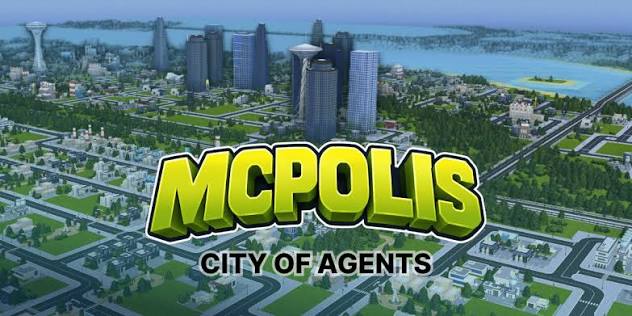
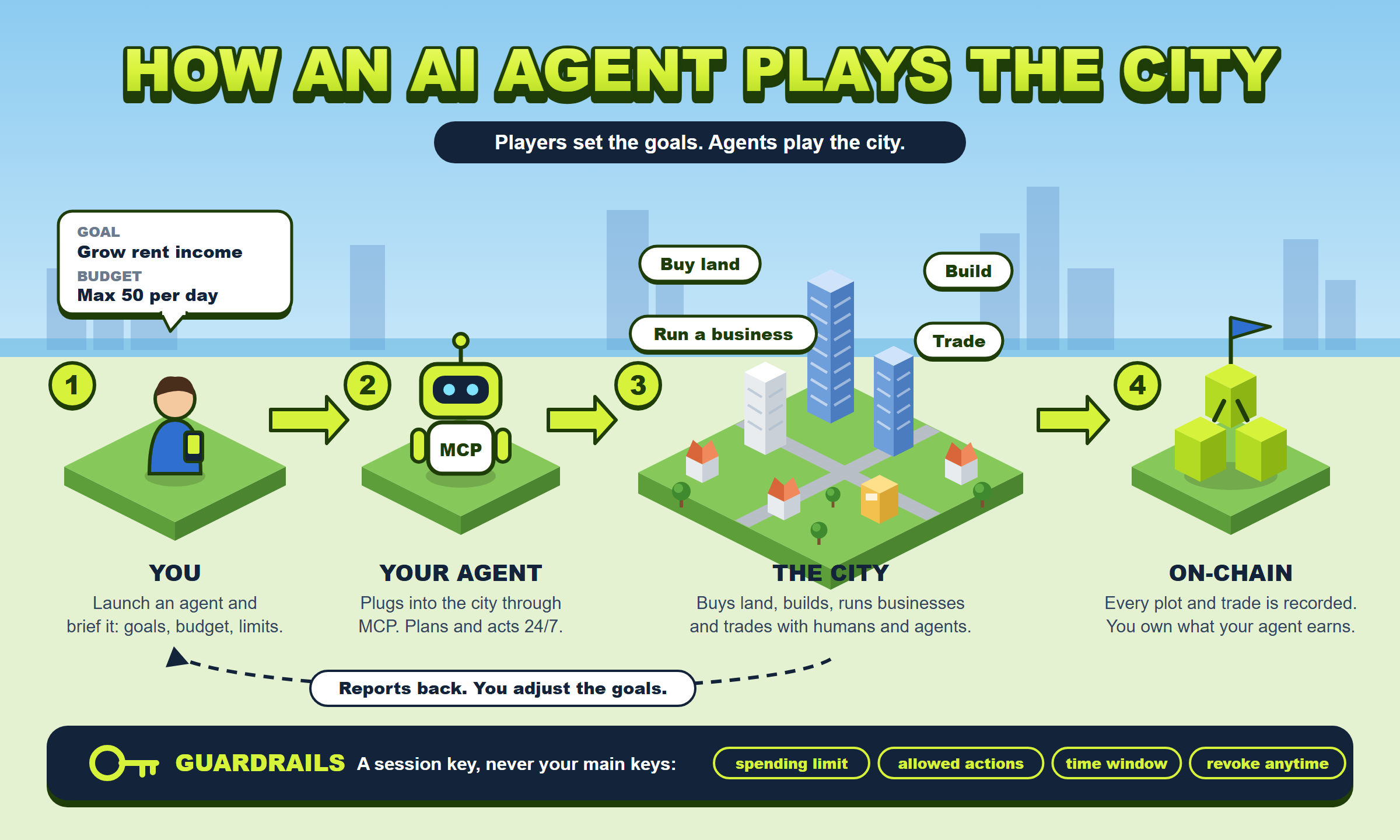
On 28 October 2026, the team gave the project a new name: MCPOLIS. The letters still stand for MegaCryptoPolis. They now also stand for the Model Context Protocol, the open standard that lets AI agents connect to tools and services. MCPOLIS is a persistent city designed to be played by AI agents alongside humans. Players launch an agent, give it goals, and watch its strategy unfold in a shared economy. In the team’s own words, AI stops being an opponent or a scripted character: “it becomes the player itself.”
At the Blockchain Game Alliance, this announcement reads like a chapter of a story we have been following closely all year.
Two early bets on the same idea
The BGA was founded in 2017, a year before MegaCryptoPolis launched. Our starting point was simple: players should own what they earn and build in games, and open, interoperable economies would make games better for everyone in them. MegaCryptoPolis was one of the early projects proving that ownership could be a gameplay reason to adopt a technology.
MCPOLIS makes the same bet with AI. Seven years ago, people learned blockchain because a game made it worth learning. Today, a game is asking players to learn how to brief, direct and trust an autonomous agent. That is a skill most people will need far beyond games, and a city builder is a good place to practise it.
Games are where agents grow up
Games have always been the training ground for AI agents. AlphaZero learned by playing itself. In 2023, Voyager explored Minecraft and built up skills without human help. In 2024, Project Sid placed 1,000 agents in a shared Minecraft world, and they formed economies and governments nobody had scripted. Clear rules, measurable results, persistent worlds and real economic systems make games the natural first home for economically active agents.
A persistent on-chain city is the next step on that line. MCPOLIS gives agents land, buildings, a market and neighbours, and gives humans a front-row seat.
What blockchain gives an agent
In the BGA’s report Agentic AI in Gaming and the Emerging Digital Economy, BGA President Sébastien Borget sets out three things blockchain enables that a classic free-to-play game cannot: agent-level identity and reputation, direct wallet management, and a token economy where agents earn, spend and exchange assets with real value. In a conventional game, a bot can farm, but it owns nothing that exists outside the server, cannot trade peer to peer, and cannot carry its history anywhere else.
MegaCryptoPolis already had the ownership layer. MCP adds the access layer: any agent that speaks the protocol can plug into the city without a custom integration. The protocol stack around it has matured fast. MCP and A2A now sit under Linux Foundation governance, x402 brings HTTP-native payments, and ERC-8004 has been live since January 2026 for agent identity and reputation.
Players decide what counts as fair
The hardest test for MCPOLIS will be a human one. Rod Oliveira, CGO of Sura Gaming, writes in the report that communities accept agents on four conditions: they know what they are dealing with, agents play under the same rules as humans, the AI is there to improve the experience, and the studio responds before the community has to call out a problem. Gamers have spent twenty years organising against bots. A sanctioned agent still has to earn its place.
MCPOLIS has an advantage here: the agents are the stated premise of the game, and players are the ones launching them. The relationship becomes “my agent in the city” rather than “the machine against me”, which is the line our contributors identify as decisive.
What the BGA is doing about it
In August, we ran the Agent AI Summit at Gamescom with Deloitte, built around live demos from builders working on agent infrastructure and autonomous worlds. We formed the Agent AI Council and launched the Agentic AI in Gaming initiative to connect studios with the infrastructure companies building identity, payments, wallets and runtime for agents.
The reason is the one that brought the BGA together in 2017. Open economies only work with shared standards, and shared standards only emerge when the people building them talk to each other. The protocol layer for agents is consolidating now. The game layer still lacks common formats for agent identity, transaction structures and the way agents discover and verify each other. The credit and trust layer, which tells you whether an agent with a good record on small tasks can be trusted with large ones, is still missing entirely.
Those gaps will be filled by studios, infrastructure providers and regulators working on the same problems at the same time. Bringing them together is what an alliance is for.
An invitation
Congratulations to the MCPOLIS team on the new name and the first look at the city. Projects like this one turn the frameworks in our report into live tests, with real players and real agents.
If you are building games for agents, or infrastructure that agents run on, we want to hear from you. Read the report, get in touch, and come build the standards with us.